






What really belongs in it – a checklist for dogs and horses, plus tips for clean documentation

Sound familiar? New patient, first appointment, and you scribble half the history on a scrap of paper you can’t read three weeks later. The anamnesis form is actually your most important tool – and yet most people still improvise.
A good anamnesis decides half the treatment. It shows you where the problem comes from, what you need to watch for, and what you must not overlook. Let’s look at what really belongs in it – separately for dogs and horses, because the cases differ a lot.
Why the anamnesis form is more than a formality
A clean form does three things for you:
It makes sure you don’t forget anything – with a full calendar, an important question slips through easily. It protects you legally, because you can show what you assessed and recommended. And it makes your treatment traceable – for you at the follow-up, and for the vet or owner when you work together.
In short: the form isn’t paperwork – it’s the foundation of good work.
The basics: what belongs in every anamnesis form
Whether dog or horse – these blocks form the structure:
Master data – Name, breed, age, sex, weight, owner contact details and the treating veterinarian.
Reason for presentation – Why are you seeing them? What has the owner noticed, since when, how has it developed?
History – Previous illnesses, surgeries, accidents, X-ray or surgical reports, current medication and veterinary diagnoses.
Housing & daily life – How does the animal live, how much exercise, what kind of load? The real cause often sits here.
Current findings – Your own observation: gait, musculature, pain points, movement restrictions.
Goal & plan – What do you want to achieve, which measures, which home exercises?
That’s the foundation. Now it gets species-specific.
Dog anamnesis: what matters
With dogs, a lot revolves around daily life and workload. Ask specifically about:
- Activity profile: How many walks, how long, ball play or agility? A sport dog needs different questions than a couch senior.
- Everyday red flags: Does he still jump into the car? Hesitate on stairs? Limp after getting up or after exercise?
- Breed predispositions: HD, ED or patella issues, disc problems in dachshunds & co., cruciate ligament ruptures.
- Prior treatment: Physio, chiropractic, underwater treadmill, pain meds – what has already been tried?
For dogs especially, a short pain and mobility scale that you repeat at every visit pays off. You see progress in black and white – and so does the owner.
Horse anamnesis: a different story
With horses, topics appear that dogs don’t have – especially around riding and tack:
- Use: Leisure, dressage, jumping, endurance? How often, how intense, what level?
- Rider & equipment: Does the saddle fit? When was it last checked? Bit/bridle topics, hoof care, shoeing?
- Under saddle and in hand: Rhythm faults, resistance, contact issues, tail swishing, saddle refusal.
- Housing: Box, open stable, turnout? Footing, movement, herd?
- Other professionals: Farrier, saddler, dental care, vet – a horse is rarely a solo case.
For horses, the interdisciplinary history is often the key: a recurring back issue won’t resolve if the saddle keeps pinching.
From scrap paper to clean documentation
A good structure on paper is a start. The problem comes after: notes disappear, handwriting is illegible, and at the follow-up you’re flipping through a folder instead of being with the animal.
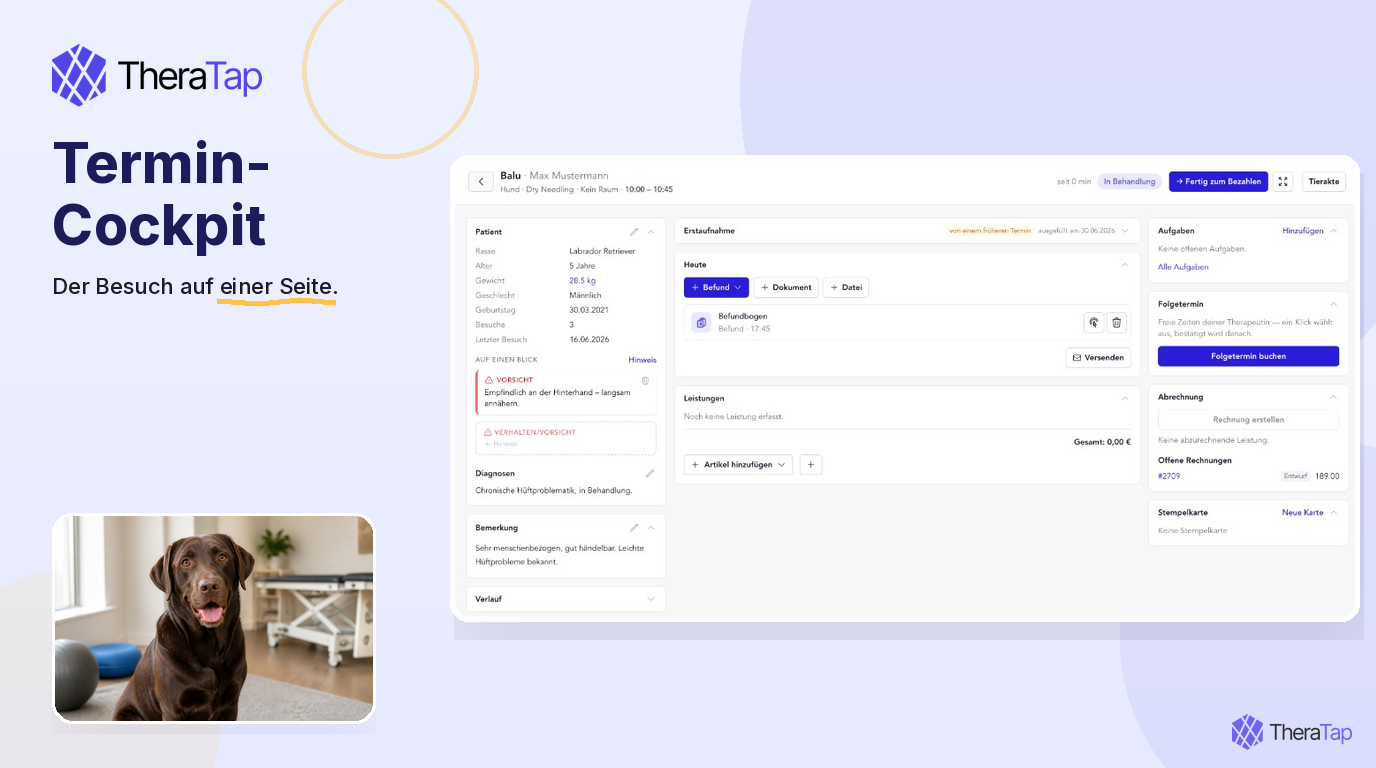
That’s where TheraTap comes in. Your anamnesis lives digitally in the patient record – with the right fields for dogs and horses, on phone or tablet, including on the go at the client’s stable or living room. Findings, progress and photos go into the same record, and at the next appointment everything is one tap away. No paper chaos, no double entry, more time for the animal.
Anamnesis is the first step – making sure it doesn’t gather dust in a drawer is the second.
Want to digitise your own anamnesis form? In TheraTap, templates for dog, horse and cat are ready – you can start right away and adapt them to your practice.